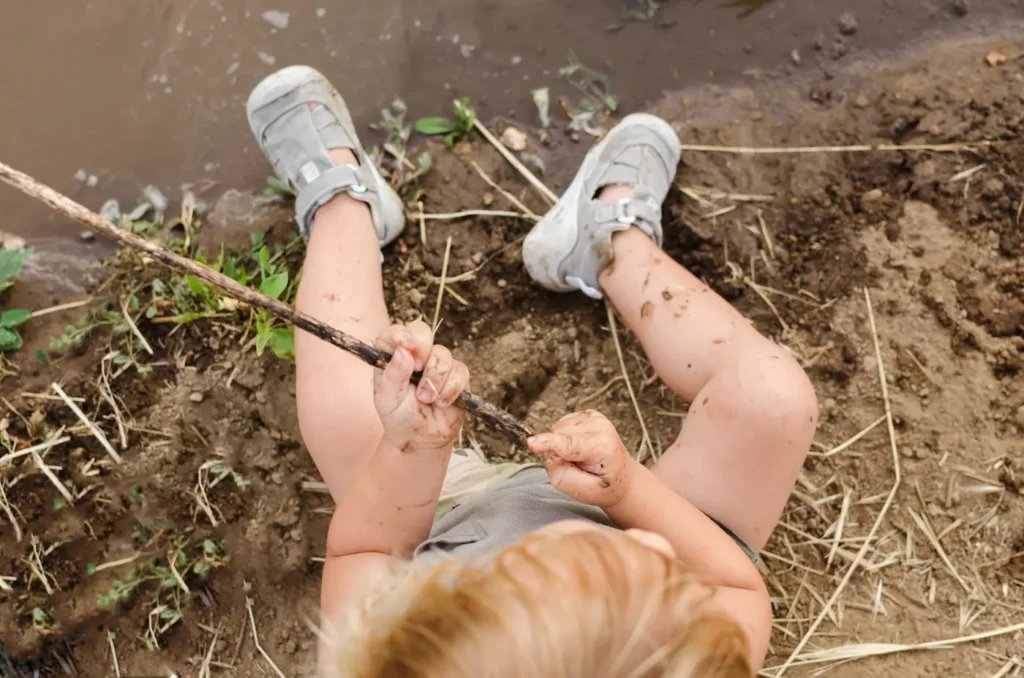
When we were growing up, playing in the dirt almost always happened naturally. There was never a need to consciously put a structural plan to have children play with earth. Often children used to get bored, and they used to venture out into the unstructured free ground around to explore and play. Kids used to just go out and play on the earth, observing insects, flies, bugs, birds, and even larger mammals too. I remember coming home with sweaty and dusty skin and clothes was not unusual.
Decades later, when kids are playing in the mud, we get extra worried about the pathogens and the toxins and bacteria in the soil. Since science found out that some microbes cause diseases, we get extra worried about eradicating them. In the process, we eliminate the opportunity to interact with the beneficial microbes too. But, parents today need to relax their attitude towards the mud and mess.
Playing in the dirt is important to build children’s immune system from the ground up. And it’s not just about the microbes. Natural earth offers various textures, the heavy stones, the flaky ones, the grass, the touch-me-not, the dragonflies, the texture of the coarse mud, the fine mud, slippery bogs, the lizard that is chasing you, and fallen flowers, and more. It engages multiple senses, making it a boon for developing bodies and minds. Falling down on earth and feeling it on your skin and feet, the soil and water escaping your fists, the squelch of mud underfoot — these are rich sensory experiences that support neurological development and improve children’s ability to participate in everyday activities.
In their book “Let Them Eat Dirt,” Canadian microbiologists B. Brett Finlay and Marie-Claire Arrieta write: “As we continue to study the microbiota of humans, it is becoming clear that our exposure to microbes is most important when we’re kids. At the same time, modern lifestyles have made childhood much cleaner than ever before in human history, and this is taking a huge toll on our microbiota — and our lifelong health.”
Playing in the open earth with fresh air on your face brings to you a certain kind of boredom to amble around watching the skies, trees, and clouds with no immediate structured goal to solve and achieve. This invites creativity and open-ended play in a way that screens and structured games don’t. Coming back to the concern around microbes, it is true that some microbes in the mud, especially in the regions of industrial places, can be contaminated with harmful microbes and pollutants. But, a vast number of microbes are harmless.
So, it is important to take reasonable precautions to be aware of the history of the soil, and build hygiene around potential creature poop, and hand washing hygiene. As parents, we may not want a child always messing in the mud, but the modern parent seems to have gone overboard with cleanliness and that if we’re going to raise healthy and resilient kids, we need to make peace with a little mess.
Playing out in the open is an excellent way to kill the boredom of a child. The natural open earth is a beautiful canvas filled with everything to observe and develop playing. Children should often get bored and should be allowed to deal with their boredom in their own way. This instills a sense of creativity, imagination, and the ability to tackle new problems by oneself. This helps children to get into something which they would otherwise not do, like observing a tailorbird or a termite house or how two ants are interacting with each other.
So, normalize the dirt and boredom around children, and don’t stress over the clean-up. After all, some dirt is good for our guts, mind, and overall well-being.
You may like to read: Why Do We Need Complex Numbers in Life?, Fun Gardening Activities for Kids, and Benefits of Pet Dogs for Kids