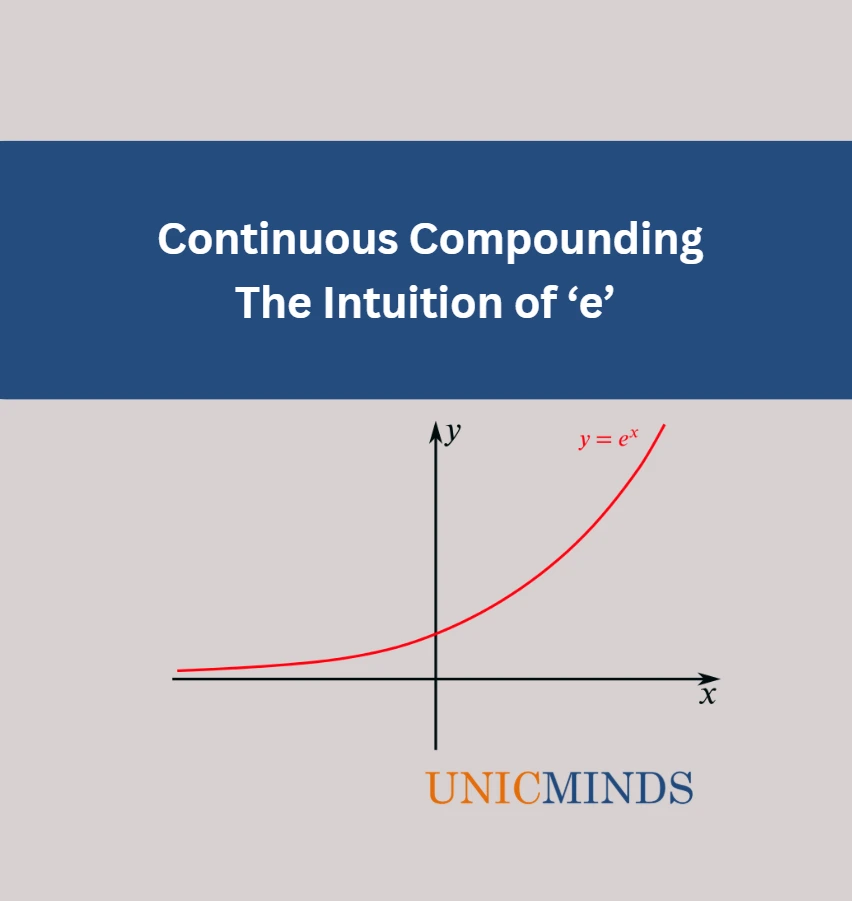
We all have used the mathematical symbol ‘e’ while doing various subjects. However, what does it really mean at an intuitive level? ‘e’ intuitively means continuous compounding. For example, if we deposit some money in a fixed deposit or a savings instrument that is providing a 6% annual interest, then the compounding is probably happening at a monthly or daily level. But even at a daily level, the compounding is not continuous. It is not like it will grow a little bit in a few hours. Even if the compounding is at hourly level, it is not continuous compounding. So, ‘e’ actually means the compounding is happening at an indivisible frequency of time. It is continuous. Now, where do we really apply this continuous compounding – in all natural things that continuously compound.
Jacob Bernoulli (1654-1705) discovered the constant ‘e’ when studying problems involving compound interest. The example he used was the most basic one he could think of… a savings account that starts with $1.00 and pays 100 percent interest per year. He calculated the interest for each of the following types of compounding.
Calculate the value of the account after one year when interest is compounded in the following ways. Bernoulli noticed that this sequence approaches a limit (a maximum value) when ‘n’ gets infinitely larger and that limit is what is ‘e’. The value of ‘e’ is 2.71828.

‘e’ is the base rate of growth of a continually growing process where every picosecond (even smaller) you are growing just a little bit. ‘e’ shows up whenever systems grow exponentially and continuously: population, bacterial growth, radioactive decay, interest calculations, and other similar examples.
How are Euler Number ‘e’ and Logarithm related?

Logarithm is the opposite of exponentiation, in a way that they cancel their effects on a variable. Hence,they are called inverse functions.
Very importantly, the below are the two ways these function combinations are used in

When ‘e’ acts as the base of a logarithm, it is called the natural logarithm ‘ln’, which describes the time needed to reach a certain level of growth. While e^x represents continuous compounding, logarithm represents how much time is required to get that growth.
e^x also implies that the interest earned is proportional to the principal amount. The larger the principal, the larger the interest. So, the differentiation of the function e^x is e^x itself. The rate of change is proportional the current value.
Euler’s number, e, is one of the most widely-used constants in mathematics, second only to 𝜋. It’s a tool that simplifies complex calculations, models growth, and makes it possible to model continuous change. It is used in cryptographic systems, monte carlo simulations, radioactive decay modelling, and many applications.
Hope this is useful, thank you.
You may like to read: The Practical Flow of RSA-AES-ECB, Odisha School Holidays List 2026-27, & Parental Guide for Roblox Usage